Month: February 2026

Honoring Black History Month with the NAACP Papers Collection

This February, in honor of Black History Month, remember that UConn Law Library houses three important digital resources: the NAACP Papers by ProQuest. The NAACP was founded on February 12, 1909, on the centennial of President Abraham Lincoln’s birth, as a multiracial coalition committed to challenging racial violence and systemic discrimination through legal advocacy, public education, and civic engagement.

Its century-long work advancing civil rights and dismantling segregation has profoundly shaped U.S. history and exemplifies the kind of social, legal, and political contributions that Black History Month seeks to commemorate and study.

The database collection is organized into the following groups:

Major campaigns for equal access to education, voting, employment, housing and the military are covered in this module. The education files in this second module document the NAACP’s systematic assault on segregated education that culminated in Brown v. Board of Education in 1954. Files from 1955 –1965 focus on the NAACP’s efforts to implement the Brown decision as well as to combat de facto segregation outside of the South.  Click here to go to the LibGuide page for this module

This NAACP module consists of the working case files of the NAACP’s general counsel and his Legal Department staff for the period from 1956 to 1972. The files document the NAACP’s aggressive campaign to bring about desegregation throughout the United States, particularly in the South.  In total, this module contains over 600 cases from 34 states and the District of Columbia. The cases in this module pertain to school desegregation, abuses of police procedure, employment discrimination, freedom of speech, privacy, freedom of association, and housing discrimination.  Click here to go to the LibGuide page for this module

One of the highlights of this NAACP module are the records on the Scottsboro case, one of the most celebrated criminal trials of the 20th century. This module also contains the key NAACP national office files on the campaign against lynching and mob violence, and NAACP efforts to fight against discrimination in the criminal justice system. Click here to go to the LibGuide page for this module

The NAACP Papers contains excellent material to support the law school community’s research projects on social justice and civil rights topics.  If you have any questions about this content, contact our reference team!


New Club Alert! RECESS: The UConn Law Social Club

RECESS co-founders,
Nicole DiBenedetto, Elena Salm, and Christina Clouser

Student organizations play an important role in life at UConn Law. Alongside rigorous academics and professional training, student-led groups create opportunities to build community, foster connection, and support one another beyond the classroom.

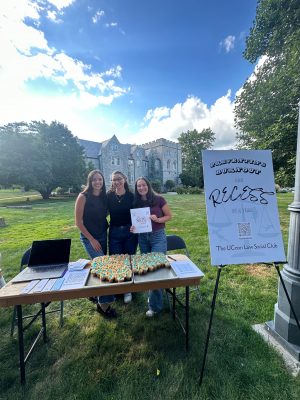
RECESS https://www.instagram.com/uconnlawrecess/ is a new organization founded by 2Ls Nicole DiBenedetto, Elena Salm, and Christina Clouser, who wanted to bring more school spirit and community to the law school campus. Seeing how stressful and isolating law school can be, the founding members created RECESS to give students a chance to connect, unwind, and enjoy campus beyond the books.


The founders of RECESS believe law students deserve a break, an actual recess, from the stress and worries of law school. Their mission is to create a space where students can connect, share interests, and build community off the record.  They aim to host 2–3 events each semester that bring joy to campus and give students a chance to step away from the books, recharge, and touch some grass!


RECESS’s next event will take place Tuesday, February 10th at 12:15 – 1:30 in the Library Cafe. Join RECESS preventing burnout, one recess at a time!

Brought to you by the co-founders of RECESS, Nicole DiBenedetto, Elena Salm, and Christina Clouser

RECESS co-founders,
Nicole DiBenedetto, Elena Salm, and Christina Clouser

Follow RECESS on Instagram @uconnlawrecess to stay up to date on all events!


Meet Michael Ampofo: A 1L’s Path to Advancing Health Equity

Photo of UConn Law 1L Michael Ampofo
UConn Law 1L Michael Ampofo

In honor of Black History Month, we’re excited to feature Michael Ampofo, a 1L focused on the intersection of law, public health, and equity. With a background in public health and plans to pursue a dual JD/MPH, Michael brings an interdisciplinary lens to legal education and advocacy. In his own words, he reflects on how the law can shape health outcomes and protect vulnerable communities.

“My name is Michael Ampofo, and I am a 1L from Bristol, Connecticut. I earned my undergraduate degree from the University of Connecticut in 2023 in Allied Health Sciences, with a concentration in Public Health and Health Promotion. My academic experiences sparked an early interest in the structural factors that influence health outcomes and the ways in which legal and policy frameworks can either reinforce or dismantle inequities.

Before beginning law school, I worked with UConn, AmeriCorps, and College Advising Corps as a College and Career Adviser at Bristol Eastern High School from 2023 to 2025. In this role, I assisted high school juniors and seniors with post-secondary planning, including résumé development, career and college exploration, applications to colleges, jobs, and trade schools, and navigating complex financial aid processes such as FAFSA, AACTUS, the CSS Profile, and scholarship applications. This experience strengthened my commitment to advocacy and exposed me to the systemic barriers many students and families face—barriers that often mirror inequities in other institutions, including healthcare.

My decision to attend law school was shaped by my passion for health equity, which developed during my work as an Honors Scholar at UConn. My thesis examined the COVID-19 pandemic’s impact on health disparities, particularly how an overwhelmed healthcare system contributed to increased discrimination by healthcare providers toward Black patients, women, people with obesity, and low-income individuals. Patient experiences highlighted the tangible consequences of discrimination in healthcare and reinforced my belief that legal advocacy and policy reform are essential tools for protecting public health.

Looking ahead, I plan to pair my JD with a Master of Public Health (MPH), focusing on epidemiology and health policy. By combining legal training with public health expertise, I hope to engage in policy development, legislative advocacy, and impact-driven legal work that advances health equity and strengthens protections for marginalized communities.

As a law student, I am motivated by the belief that the law is a powerful mechanism for addressing systemic injustice. Through my legal education, I aim to contribute to solutions that promote equitable health outcomes and ensure that public health considerations remain central to legal and policy decision-making.”