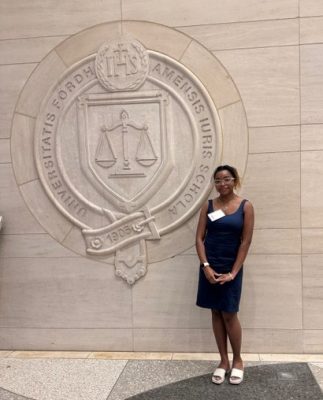
UConn Law Library is proud to continue celebrating Women’s History Month by spotlighting future human rights attorney Addys Castillo. We’re proud to highlight the achievements, voices, and stories of women who inspire and lead, especially those helping shape the future of the legal profession.
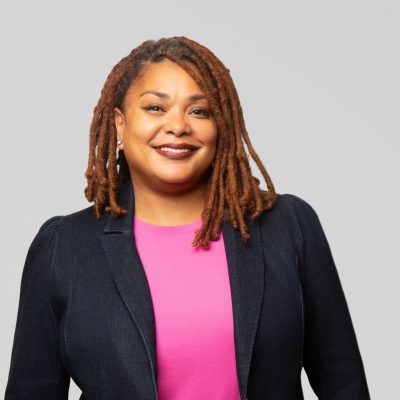
In this Q&A, law student Kwaku Aurelien returns to sit down with Addys to reflect on the importance of building power through community.
Kwaku opens the conversation with a question that invites reflection:
KWAKU AURELIEN:
Give us a portrait: Who is Addys Castillo?
ADDYS CASTILLO:
I usually introduce myself by answering three parts: Who am I? What do I do? And what is my urgency for the work that I do?
First, whose I am. I am the daughter of Eneida Arroyo and Jorge Castillo. I like to say that I’m my mother’s daughter. And I’m just like her. The older I get, the more I realize I am just like her. My mother is in her 70s and has always worked in the city of New Haven serving the elderly population. For a good portion of my life, I’ll go into spaces and people will say, “You’re Eneida’s daughter, right?” I don’t have an identity outside of that sometimes, and I love that.
I’m also a mother. I am Robbie’s mom, and my son is the centerpiece of the inspiration for a lot of the things that I do. He’s now 22, a senior in college. I’m also a foster parent, so I have other bonus children that I’ve raised. In total, I have four sons who I love very dearly.
What do I do? I’m a student at UConn Law. Before that, I was an organizer and executive director of the Citywide Youth Coalition, where I organized young people in the city of New Haven. I am a Core Trainer with the People’s Institute for Survival and Beyond, with over 4,000 hours facilitating anti-racist community organizing. And I am the founder and director of Movement Defense Strategies, a nascent project aspiring to be a nonprofit law firm that provides legal counsel, education, and strategy support to organizers in Connecticut.
Outside of that, I am an artist. I’ve been a dancer for a good portion of my life. I discovered drumming and singing a couple of years ago in 2019. My practice is specific to Puerto Rican, Afro-Puerto Rican roots – bomba – and it propels me. It gives me life to continue this work.
My urgency is that I’m an organizer and a mother of Black children. I came to law school to learn the system and to learn how to dismantle the system from the inside. Most importantly, to have the expertise in the room so that when we’re trying to change laws and practices within government or local institutions, we have a clear understanding of what that means and someone who can champion the cause.
My urgency is rooted in my sons. As someone who has worked in criminal justice reform and even spent time as a correctional officer, I know the battle for racial justice is going to be won in criminal courts, because that is where you see the greatest disparity. I got tired of constantly having to look for an attorney to be in the room when we’re doing organizing work. I figured, why wait for someone else to come and do the work when I can do it? I did it at this particular time because I waited for my son to be in college so that I could have more time to dedicate to the work.
KWAKU:
What would you say law school has taught you about organizing, if anything?
ADDYS:
Organizing has made law school much more manageable. When we go into law school, we get taught this idea that we’re competing with each other for grades, rank, or jobs. But I couldn’t have survived law school without the relationships I’ve built with my classmates.
My first class was an LRW (Legal Research and Writing) course. That professor made us believe we weren’t supposed to work together. He said, “You’re not supposed to work together under any circumstances.” I felt like I was walking around blind my first semester. Then second semester, another professor said, “No, you’re supposed to lean on each other. You’re supposed to work together.” The minute I started working with other people, the doctrine started to make sense.
Organizing has taught me that everything is about relationship. Most of the time we go into these spaces thinking we’re in competition, but in actuality, we’re colleagues, protectors of the Constitution. It behooves me to be in good relationship with folks and not demonize anyone, but to see the humanity in everybody.
KWAKU:
What would you say you knew from your organizing experience that your classmates and professors didn’t know?
ADDYS:
Real-time experience with conversations about race and racism. It amazes me, specifically when we’re talking about criminal law and constitutional law. Race came up in Constitutional Law more than in Criminal Law. When we talked about the Dred Scott decision and Plessy v. Ferguson, my classmates were uncomfortable having that discussion. Even more, my professor didn’t have the information.
Most of the time we shy away from these discussions about race and racism because we don’t understand how this stuff has been constructed. Part of my work with the People’s Institute is having a grounded understanding not only in case history but understanding the history around the construction of race globally.
When we started talking about the Dred Scott decision, no one wanted to go into detail. The professor looked uncomfortable. Eventually I said it out loud. She made a comment about the justices wanting us to strive for a colorblind society. I told her in that moment that colorblindness is a sickness. You wouldn’t walk around wanting to be colorblind. You can’t tell me you’re colorblind and you drove here, because then you wouldn’t have been able to see the green light or the red light.
I sat down with my professor and asked her if, as her TA, we could have a discussion about what race is as a construct. She allowed me the opportunity, and we had a brilliant discussion. In that space, I helped people understand that: one, none of us are born with race—we get assigned a race; two, this is a construct created specifically to keep a divide; and three, there’s no way we’re going into the legal profession without this understanding. Otherwise, we end up tripping all over each other.
That is one of the things I have brought into the room, the idea that we have to be humanistic in how we approach the law. Once we are comfortable calling out the elephant in the room, we can actually do a much better job of disrupting how this elephant got in here in the first place.
KWAKU:
As far as Movement Defense Strategies, what is it and why is it needed?
ADDYS:
Movement Defense Strategies started because I wanted to create a law clinic when I got to law school. Organizers don’t have all the legal tools available. Most organizers have never read the Constitution. They’re doing work, trying to move things, but they don’t even know the rules or the floor, never mind the Connecticut Constitution or city charters.
I thought it would be wise to create an organization that would do a couple of things. Number one, bridge the divide between organizers and the legal profession. A lot of times organizers have firsthand knowledge about policy and practice when it comes to law, but they don’t necessarily have the legal language or understanding of fundamentals to bring critique or get it to the place where we can actually litigate.
Number two, we have a lot of law students who have promise but don’t ever get to have authentic relationships with the people who need them most. They’ll help corporations or other organizations, but I’m talking about helping the people who are doing the most work with respect to changing laws and policy. Grassroots is where the power is.
If you look at the work that the Panthers did when they got established in Oakland, the first thing they did was educate people on Second Amendment rights. It was all about educating folks on the law so people were clear in order to move. The idea of Movement Defense was just that—the movement needs defense.
Anytime there’s an entity that has money and wants to push an agenda, they always have the top law firm behind them to figure out procedure, argument, lobbying. Most of us doing organizing work either are under a 501(c)(3), which means we can’t lobby, or we have no 501(c)(3) status and don’t have money to access attorneys when we need them most.
I took the Legal Entrepreneurship class taught by Professor McKeen, put it on paper, and it actually got me the CALI Award. I circulated it to a couple of foundations and managed to secure some funding.
What we’re starting with is legal education. Along with Hannah Govan, one of my classmates, we created a curriculum called Con Law 101 for Organizers, just to give them an understanding of the levers of power the Constitution provides. Not so much about individual rights, but we want them to understand where the powers lie so we can eventually talk about legal strategy.
If you look at the movements in the ’60s, they had not only galvanized folks and gotten people to move, they had a legal strategy and an economic strategy. Today, we have a lot of anger, a lot of passion, a lot of demands, but we don’t have a legal strategy. We might win small battles, but we’re not winning the war because we don’t have a strategy. That’s what I’m hoping we’re going to get with Movement Defense.
There’s also a dual role here. Not only do law students get recruited to help out, they get paid for their work. I took issue with the fact that as law students, we pay to work in clinics. We pay to get experience. We pay to do internships. We pay for research credits.
What would it look like if a firm like Movement Defense Strategies came along with projects where we pay law students competitive wages, anywhere between $22 to $25 an hour, to help create research, write narratives, and publish articles? This is an opportunity for law students to get their feet wet doing public interest work while working in tandem with organizers who have a lot to educate us on as people who are going to be the protectors of law in the future.
KWAKU:
What legal threats would you say grassroots organizers face?
ADDYS:
Criminalization on a whole other level. Right now, I’m really worried about what’s going on with ICE. Even locally, Hartford PD just recently shot a second person [Steven Jones] who was having a mental health crisis. I’ve been organizing in Connecticut around police accountability for over 30 years. I remember 1997 when Malik Jones was killed on Grand Avenue by an East Haven cop who was outside his jurisdiction as a result of a police chase. Here we are almost 30 years later, and these kinds of things still occur. The police are able to do things to our community without any accountability. Qualified immunity still stands.
When I think about pressing threats to organizers, one of them is safety. Are we safe while we are defending and resisting? Are we being surveilled? Surveillance is not just what you’re doing outside, but what you’re doing through our computers. Under an administration looking to limit any kind of freedom of speech folks thought they had in the past, those are real issues that keep even lawyers from getting involved out of fear that they too can lose their careers trying to defend people the government is against.
KWAKU:
What would you say protecting movements and organizers from criminalization looks like in practice?
ADDYS:
We’re going to have to get back to basics. Get off the internet and get back to meeting face-to-face in spaces without phones, building relationships so we can be better equipped to support movement work. I’m talking about lawyers, law students, professors, peace officers, clergy. How do we come back to actually having a nucleus and making sure we have a strategy to defend each other?
I think about the National Lawyers Guild and their protest observation trainings where they tell you when you go, you’re there to observe. But even observers can be in the line of fire in this moment, given how things are panning out. How do we recruit more people to do that kind of work? How do we gain the trust of organizers so we can inform them and find ways to keep them safe?
I don’t have all the answers when it comes to safety, but because of what’s happening on the streets right now, I’m afraid to go out sometimes. I try to find different ways I can make myself available to support movement work, whether that’s raising money, accompanying people to court dates, or mapping out resources. I know folks who are delivering food for people out of fear that they can’t leave the house out of worry they might get taken or kidnapped.
We all have different roles to play. But if we leave lawyers and law students together to figure it out, we’re not close enough to the street to understand what’s needed. Before we can help, we have to build actual relationships with the community we’re trying to protect.
KWAKU:
You’re going to be an assistant district attorney in the Bronx upon graduation from law school. How would you say that’s reconcilable with protecting movements from criminalization and broader liberation work?
ADDYS:
I took the job specifically because the Bronx DA is a very progressive district attorney’s office. I fell in love with the way Darcel Clark’s philosophy, “Justice with Integrity,” spoke to me. I also know that litigators are the scariest lawyers to have because trial lawyers are a dying breed.
There’s a lot of power prosecutors hold. In order to challenge the system, you’ve got to know the system. The only way to know exactly what a prosecutor’s supposed to do and what they shouldn’t be doing is to actually hold that seat.
What I anticipate doing with that information once I’m no longer a prosecutor is using it specifically to fuel the strategy around defense and to educate organizers and other attorneys. My understanding of surveillance today is much clearer because of my time at the Bronx DA. Do you know that they have units of interns and police officers that just look through your webpages and look at all the comments on your posts? They sit there and decrypt your stuff. Surveillance already exists. It’s just a matter of when it’s going to point at you. I wouldn’t have known that had I not been in that position.
You’ve heard of the book The Spook Who Sat by the Door? To me, that’s what being a DA would be. I’m hoping I can take the knowledge and understanding as a prosecutor into movement work, specifically to help us strategize better and to hold systems like the district attorney’s office and police officers accountable when we know for sure what they’re supposed to do.
As a foster parent, I’ve been able to hold DCF accountable because I used to be a DCF worker. When they come at me, I already know their job. I know what you’re supposed to do. The same thing applies with movement work and the prosecutor’s office.
KWAKU:
Would you say prosecution can be a tool for justice? Is it inherently part of the problem, or is it both?
ADDYS:
I think it could be a tool for justice. Absolutely. As a prosecutor, I’m disheartened by the fact that the federal government has unleashed agents who have been able to kill people without any type of retribution or accountability whatsoever. The law is the law, no matter who’s breaking it.
Although I recognize that it is inherently problematic, part of my work here – and I’m very inspired by Darcel Clark – is her approach. As someone with sons, one of my sons got caught with a gun and ended up having to do time. In New York City, in the Bronx in particular, because she started to analyze why young people were carrying guns to school in the first place or just having guns period, she came up with a project where if someone is caught with a gun and they have a weapons charge, they have to spend a year in family therapy and complete it fully in order to have the case moved and that be considered the sentence.
To me, I thought that was brilliant. Instead of going at you for what you did, she’s trying to help understand why you did it in the first place and address it. And if that doesn’t work, then you’re going to jail. That kind of approach to justice speaks to me.
We still need friends to play their positions in whatever role they’re in. Maybe my contribution to justice would be to remain in that position in order to be fair to the folks that come before me. Because the truth is, the DA, the prosecutor, sets the tone of the game, not the judge. They decide what game we’re going to play, what charges we’re going to go forward with in the first place. That’s where the power is.
KWAKU:
What would you say a values-driven approach to prosecution looks like?
ADDYS:
It centers integrity overall. Meaning, did we do things right? Did we preserve everyone’s constitutionally protected rights? Did we make sure we did not cut any corners so that we’re not just going after people for the sake of having statistics, but that we’re going after the right people?
The other approach is having a holistic approach to looking at crimes that are committed. I come from a line of folks who believe in abolition, and I might be odd saying this as someone working in the system, but I don’t necessarily think I’m against prison. I say that lightly because I recognize there are violent offenders, people you don’t want on the street. However, I don’t think we do a good enough job of limiting the number of nonviolent perpetrators. Most of the time, those are crimes related to need.
We have to be holistic in our approach. We have to look at what actually perpetrates the need in the first place for folks to commit the offense and create solutions that are much more rooted in restorative justice, more so than just punishment, because punishment doesn’t work.
KWAKU:
You did work in the Conviction Integrity Unit to investigate wrongful convictions. What did that teach you about who gets wrongfully convicted?
ADDYS:
The first thing I learned is that in a Conviction Integrity Unit, you are the odd man out. If you’re in a prosecutor’s office and you’re handling conviction integrity, it’s the equivalent to being a police officer working in Internal Affairs. You’re not going to be popular.
However, I came to appreciate the attorneys in that unit, most of whom were former defense attorneys, not prosecutors. They were all about reinvestigating – looking at the file bare bones from the beginning to identify whether the ID was made lawfully and whether someone was legally innocent.
In a couple of the cases I reviewed, the theme was that the police cut corners when they were doing their investigation. What I learned in that unit is that conviction and that kind of injustice can be avoided by virtue of the first prosecutor who sees the file. That first prosecutor’s job is to investigate every piece of the story, to talk to every witness before moving forward with filing charges.
The woman in charge of that division said, “It’s rare for people to end up in jail for this, which is why integrity has to be paramount.” Most of that stuff doesn’t become a stain on the justice system, but a stain on the actual person who did the investigation and their sloppy work.
What that means for me now in New York is they were doing pretty good work, but most of the exonerations they achieved were after someone had already done their time. I just want to put that out there. They didn’t take people out of jail. These were people fighting their case and still fighting for their innocence after they had already spent years in jail.
If you look up the statistics with the Innocence Project, 20% or so of exonerations have come out of the city of New Haven, Connecticut, which tells you about the corruption that swept through the police department. Despite that, there’s never been an actual investigation of the police department or the prosecutors who handled those cases in the ’80s and ’90s.
As a prosecutor, you’ve got to take your job very seriously. It shouldn’t just be about trying to convict someone for the sake of conviction, but doing so crossing your T’s and dotting your I’s, making sure you got the right person. If something is questionable, being able to question it, even if it means we may not get the outcome we’re being pushed to get.
Integrity is making sure we follow protocol and process to ensure we don’t have the wrong person locked up.
KWAKU:
What does anti-racist community organizing mean in practice?
ADDYS:
Racism dehumanizes everyone, not just people of color. Whether we get dehumanized by the way we’re treated or the way we get programmed to believe we’re less than, or by virtue of how folks who are the dominant culture are treated like they’re better than and start to believe they are somehow above reproach. It’s dehumanizing, period, to everyone.
When I think of anti-racist organizing, I think of the complete opposite – bringing humanity back into the way we do our work. Instead of saying anti-racist organizing, change that to humanistic organizing. Instead of us being against each other, constantly at each other’s throats, we can see that we have some things in common. We can respect the fact that we may not agree, but that does not take away your humanity.
Organizing is rooted in principles I live by completely. Number one, I’m always analyzing power – what power am I holding, what is the dynamic I’m in? And before that, history. Everything I do when I’m organizing is rooted in history. Before I start any conversation with a new group, I make sure they understand how they got to be in this room. We live in a country that’s very anti-history. They’re trying to rewrite it right now, right out of the books.
We analyze power. We develop leadership. I don’t think I’m a leader because I have a position. I think I’m a leader because of the actions I take. When I work with folks I organize, all of us are leaders. It just means that at different points, everyone’s going to step up to do something. I’m always making sure I’m developing other people the way they’re developing me.
We transform gatekeeping. All of us have access to a gate we keep, whether we work in a place where we can give access to someone, or as law students, we have all this knowledge about the law. We can either share that knowledge with people who don’t understand it, or we can gatekeep it. We transform that gate to give more access to people, and we’re cautious of some of the folks we let in because we don’t want them to create harm.
We understand the manifestations of racism. Most people think racism is prejudice and bigotry. In actuality, we’re talking about policies and practices that are upheld culturally – individual acts perpetuated by a culture of racism in a space upheld by policies and institutional practices, and often enforced by militarism. Understanding that helps us maneuver.
We share and celebrate culture. People get caught up thinking that culture is something they’re too far away from. I’m talking about the things that give us life. My mother came over a couple years ago and insulted me because I didn’t have a coffee pot. She said, “What kind of Puerto Rican are you? You don’t have a coffee pot in your house?” I didn’t drink coffee at the time. But I thought about it. My mother is the kind of woman who will feed you anytime you come to her house, and the first thing she’s going to offer you is coffee because this is the way she wants to love on you.
I used to be a social worker for DCF. The first thing they taught us was when you go into people’s homes, don’t take bribes. And a bribe to them is also accepting water or coffee. Which I thought, in retrospect, is so devoid of an understanding of culture. If you come to my mama’s house and she offers you coffee or water and you turn her down, she’s going to think you don’t like her or you think something’s wrong with her stuff.
When I share this story in organizing spaces, people start smiling and saying, “My mother does the same thing too.” Because when we share cultures, that’s when we actually connect with one another. You start seeing we’re more alike than we’re not. That’s why culture sharing is important.
We have to understand and be comfortable addressing the way we internalize racism. For folks of color, we wear it as these deficiencies we always have to maneuver, we have to code switch, we deal with colorism. For white folks, they have their own way of internalizing racism that manifests in the way we interact. But when we’re in real relationship, I can call that in.
I have a good friend of mine, Kyle Peterson, who I’ve been organizing with for almost 10 years. At one point, I was looking for a board member to join my organization, and he offered. When he offered, I felt real uncomfortable. I couldn’t understand why. Eventually we talked, and I said, “I know you meant it with good intentions, but I feel like it was your paternalism showing up. You want to come in and control me.” It was the most honest discussion I could have had with someone I’m trying to build a relationship with, by actually giving context and words to the feeling and the action.
Lastly, we build networks. You can’t afford to throw people away. Everybody has to be part of this. Sometimes you’ve got to put people on timeout. Sometimes we have to rebuild old bridges. But I’ve got to build a network with the people.
My whole approach is exactly how we’re running Movement Defense Strategies, with this idea that we want to educate folks, build with folks, support folks, and be held accountable for the way we’re doing work. This is not about us being in a position to tell people what to do. We want to be in relationship and partnership. We want to be co-conspirators with the folks that need the most hope.
KWAKU:
How does your Afro-Latina identity shape your approach to organizing, law, and life in general?
ADDYS:
Black lawyers make up 5% of all lawyers. If you start looking at Black Latina women, we’re like a fraction of a fraction of that. I use it as my superpower. As someone who’s been maneuvering in spaces for three decades, that identity feels more like a superpower now than ever because I can relate to other folks’ struggles or at least be able to bring that empathy with me. Even when I can’t relate, I try my best to find the intersection of understanding between us.
Constitutional Law became my favorite subject in law school. The way the professor taught it, she always gave the backstory to the case. When you heard the whole story, you could see there was some noble intent in both parties’ arguments. I have developed a lens because of that and the way I maneuver in this world. I bring that understanding with me. I speak to understand others rather than be understood. I’m hoping that if I model that for other people, they’ll do the same for me. I come in always from that perspective of looking at people like I’m looking at them for the first time.
KWAKU:
At the beginning, you described yourself as an artist and also in your bio as a cultural worker. How does art inform not only your legal work but also you as a person?
ADDYS:
I am really grateful for having not only discovered arts early in life but having gotten into cultural practice of artistry in my later years. As a Black woman in this country, being Latina has been a source of contention for me. Not with Black folks, but with other Latinos who will deny or try to test me to make sure I am what I say I am. Yet when I’m with Black folks, that’s never a question. It’s just acceptance.
When I came into this cultural practice, I felt something was missing. Part of doing anti-racist organizing is that we need to understand we got here from somewhere. You are Black, but before you were Black, you were something else. What about that?
I took a trip with a girlfriend of mine to West Guinea for three weeks of dancing and drumming. I fell in love with it. When I came back home, I took my family on vacation to Puerto Rico, and we stayed in Loíza. Loíza is what we call La Capital de la Tradición, the capital of tradition, because Loíza was the Blackest part of the island. It was the part where freed Africans lived, where enslaved folks ran away to. This was the place on the island where that tradition lived.
As we were driving through, I saw the Loíza flag, the town flag. Do you know it’s identical in color and almost in every way to the West Guinea flag? I was blown away. I started seeking, “How do I get to know more of this history?” Because despite the fact I grew up Puerto Rican and this is in my blood, none of this was ever talked to me. Going back to history, even in my own family, there’s a shame with being Black. That has to be something we acknowledge.
I picked up a drum, started drumming because I wanted to dance, and to dance, you’ve got to understand the drum. What it’s done for me, especially in legal space, is that it actually helped me with litigation. I’m not a scary public speaker at all. I’m someone who used to sing in the shower, but it turns out my voice is perfect for the kind of singing I do when we’re talking cultural songs.
I bring that same energy of storytelling through song and through dance into the courtroom, into my briefs, into my appellate arguments. I use that as my secret sauce because I’m comfortable, and I channel my ancestors with me at every step of the way. When I feel like I’m backed by my ancestors, I feel invincible in any position you put me in. I bring it with me because I don’t think you can have justice without culture. We can’t get to the place of finding relief for everyone if we’re not going to be able to see the humanity in everyone at the table. And we only get to see each other’s humanity when we can see that we all share a culture.
KWAKU:
As far as founding MDS and working within other organizations, what does it take to build institutions that serve movements? Does it take any type of special expertise, or is it something you just learn as you go?
ADDYS:
You need to be in relationship. I think back to what I said before. I’m grateful I found my tribe at law school. I would have quit school after my first year had I not found some people to study with because I learned we all brought different skills to the table. Some people are really good at understanding the doctrine. Some people are really good at putting together flowcharts. Some of us are really good at memorizing case law. Me, my gift is that I’m a big-picture thinker. Once you throw everything on the wall, I see the connections, the distinctions, the similarities.
The idea of building Movement Defense, the first thing I knew is I wasn’t going to be able to do this alone. I came up with the idea, but it was really an idea fueled by all the organizing happening during COVID and me and my colleagues being frustrated that things were not moving and people not understanding. We have all the people with the expertise working on policy they never talk to us about.
If we’re talking about building an organization or institution for the movement, you can’t do it by yourself. You’ve got to include the people who are in the movement to inform you. You’ve got to include people who bring different skills. I’m a visionary and I love to dream with other people, but most of what I’ve been doing in law school is building relationships with folks that I can get to come join me on this because I see that their fire is in it too. They may show it in a different kind of way, but it is still fire.
I get excited about this work because I’m organizing with people who, all I’ve been doing in the last four years is getting to know what makes them tick so we can get together and build this. I want to build a firm with some folks. I don’t want to do this by myself. I’m cool walking the plank and trying to find the money on my own, but relationships carry you. I wouldn’t have been able to secure funding for Citywide or for MDS had I not built relationships with funders, with other institutional heads. And not only relationships with them, but they got to watch me over time walk in my integrity.
None of that got done by myself. I don’t walk alone. I walk with a posse all the time.
KWAKU:
You were a National Urban Fellow focused on trauma-informed responses in justice systems. How does a trauma-informed lens shape your work?
ADDYS:
When I got brought in to work for the California Endowment, which was a healthcare foundation, they were all about health, health, health, health, health. To them, health meant injury – someone physically got injured. I wasn’t a doctor, nurse, or any of that. All my experience had been working in nonprofit and triaging folks who were either coming in from jail, going to jail, or folks who were in the in-between.
What I got them to see was something already being talked about in the ACEs study—Adverse Childhood Experiences. The study asked 10 questions, and some of those questions weren’t necessarily about physical injury. They were about: Did you have an incarcerated parent? Was somebody drug-addicted? Did you grow up in poverty? Did you observe violence? What they found is that the higher your ACEs score on a scale of 1 to 10, the more likely you are to suffer from things like diabetes, cholesterol, and heart attacks.
They did the same study on six-year-olds in San Francisco, and the kids had scores of like six. My whole time there was about getting them to pivot and acknowledge that there are social determinants that impact health. Trauma isn’t just about physical injury—it’s traumatic to grow up in the hood. It is a constant space where people are being killed and you’re living in poverty and you observe violence. Those things are just as traumatic.
With respect to how that shapes my legal work, it completely shapes how I approach my organizing and strategies when it comes to resolutions for the kind of work we want to get done. We cannot just focus on physical injury. We need to focus on the root causes of the issues.
Again, I go back to Darcel Clark trying to reduce violence in the Bronx. She’s targeting not only violent crimes but also weapons charges. But her approach to weapons charges isn’t just “lock them up.” It’s, “What is causing this deficit? What is causing this need to feel that you need to protect yourself? Can we address that?” That’s actually made me a better organizer because I have to be informed by the bigger picture. I can’t just look at a client or a classmate and assume they’re difficult for the purpose of being difficult. The immediate question I ask myself is, “What’s going on with this person?” Because there’s something more here.
I bring that lens with me in the work that I do because it helps me navigate through possible solutions and identify possible partners to help come up with solutions as well.
KWAKU:
What did your work coordinating crisis services for domestic violence and sexual assault survivors teach you?
ADDYS:
I learned how much bias I carried with me from my work as a correctional officer into that particular space. I’m going to call myself in on this one and say when I started doing that work, I didn’t have a trauma lens.
I got hired because they thought I could clean up the house. I ran a shelter, and one of the requirements for the women was that they could not disclose their location to anybody else. If they did, they would be forced to leave. Also, if they were found with contraband, i.e., drugs in the facility, they would also have to leave. Coming from working in a jail setting, I was pretty by-the-book.
In retrospect, I feel like I did harm because I didn’t understand trauma the way I understand it now. Some women came in and they were self-medicating. Instead of us addressing anxiety and depression, we just showed them the door.
I recognize that was the incorrect way to handle that. What I learned in that space is that we have to be more compassionate. We can’t rush to make assumptions about the people we are serving. I made a lot of assumptions because my job was to keep the house together. I didn’t make the assumption I needed to make with respect to anyone caught up in a cycle of addiction by virtue of trying to ease pain that hasn’t even been addressed yet.
If I could do anything over again, I would have done that job totally differently. I recognize they brought me in to be the hammer. I didn’t like that after some time, and I didn’t last long. But I learned a lot from being in that space. We have to be more compassionate and more open to understanding the full situation.
KWAKU:
Having been in public service since the ’90s, how would you say the justice landscape has evolved since you started?
ADDYS:
I think today’s generation is much more alert than I was in the ’90s. When I first got into doing community service work with young people, I didn’t even pay attention to politics. I was just too busy living my life, trying to do me.
I think about the young people I’ve worked with in the last 10 years and how evolved and aware and informed they are. If you want to study what movement work looks like in Connecticut, look up Connecticut Students for a Dream. This was an organization that started off as a group of undocumented students who were fighting to get access to in-state tuition and resources as students at UConn. They fought for almost 10 years to get a bill passed to get those resources. But it was young people. They were in their teens, and they’re the ones putting pressure on the legislature.
When I think about what I was doing in the ’90s compared to what they’re doing now, I’m just like, we weren’t doing anything. My justice focus came after college. I would even say it came as a result of working in jail and watching young men, young boys.
I loved and hated my job when I worked at the jail. I loved it because it was the best training I ever got, and I learned a lot about myself and young people. I hated it because I didn’t like the way the institution forced us to work in that space.
When we were there, I remember some of the boys who were there had turned their whole attitude around. They thought they were being discharged and going home to their grandma’s house or their auntie’s house, but they were being escorted to a shelter because nobody would take them in. For me, that is when my justice lens kicked in. I can’t believe I’m part of the system that’s doing this. What are we doing to help?
That’s what made me become a foster parent. That was my remedy for that. I’m not afraid of teenage boys, and I have extra rooms in my house. I’m okay with them being here because I know how the system is set up. Especially if you’re already coming in with a disadvantage of living in poverty or not having family, this is where I could be of most help.
In the ’90s, I was oblivious. I was not paying attention. ’97 became my awakening when Malik Jones was killed. That’s when we got activated. That’s when we got involved. But that was college, not high school. I envy young people today because they pay more attention to that stuff now than I did when I was in high school.
KWAKU:
What would you say gives you hope having seen so much injustice in this country and in the world?
ADDYS:
Without a doubt, people give me hope. Young people give me hope. My sons give me hope. I love to see them thriving. I love to see them maneuvering.
I feel very hopeful being at UConn. I feel like there’s pockets of space where you find some really dope people at UConn. I’m grateful I came across the Black Law Students Association and was able to make friends with people outside of my cohort. Being around the brilliance of some of our classmates gives me hope. Seeing professors who are actually making room to have these kinds of conversations gives me hope.
I’m very much inspired by the work I see across the country when I work with the People’s Institute. That work gives me hope—to see people who sign up on purpose to want to understand what race and racism is and to work together to dismantle it.
I’m very hopeful these days, despite what we see on TV, despite what we see on social media, because I can tell you this much: The fact that we’re even having the conversation means we’re willing to do something about it. That gives me hope. Even the fact that you wanted to interview me to have this discussion and share with other people—I’m hopeful that whatever it is we are willing to work together to get done, it will get done. But it requires us stepping out of our little corners and taking a chance to be in relationship with people who are not necessarily like us.
I find myself very hopeful these days because I know I’m not doing this by myself. I know I have a whole cadre of folks across the country that I lean on. I’m very excited about the future because of the energy of young people who are fighting the good fight and the adults that are supporting it. I’m looking forward to the future.
KWAKU: Is there anything I haven’t asked that you think is important for students to take away from your journey and the work that you’re doing?
ADDYS: Yes. You don’t have to wait to graduate law school to do something with your degree, to do something with the education you hold, to do something with your gifts.
I’ve been awakened in law school by taking International Human Rights. When I took the class, I was kind of like, “This is bullshit.” It feels like these are all things that are aspirational, but how do you enforce something when there’s no enforceable mechanisms in place?
Then I was reminded by Professor Molly Land, who said, “Are you one of those people who, when you bring out your cart from the grocery store, do you just leave it wherever, or do you move it back into where the carts are?” It became like a litmus test to see what we do when no one is enforcing a rule. I started observing myself and not even worrying about other people but living the life I want other people to live as well with me. It has to start with me.
The only thing I would have to share with my classmates is that I hope you will all take this and use your gift to better somebody else’s outcomes. Whether you’re doing it at a clinic, whether you join Hartford Deportation Defense, or whether you do it at a school, what are we doing even though we’re not forced to do pro bono work? What is your commitment to being of service to those who don’t have it?
You don’t have to wait to graduate to do it.