Month: September 2026

Introducing: The Ioffe Collection

Few scholars have had as much influence on the study of Soviet civil law as Olimpiad S. Ioffe (1920-2005). Born in what is now Ukraine, Ioffe became one of the Soviet Union’s most respected legal scholars, serving for more than two decades as chairman of the Civil Law Department at Leningrad State University before emigrating to the United States. After a fellowship at Harvard Law School, he joined the faculty here at UConn Law, where he continued his scholarship and teaching until his retirement in 1998.[1]

Following his death, his family graciously donated his entire personal library of over one hundred titles to the UConn Law Library. Most are in Russian, but his broad and varied collection includes a smattering of titles in languages such as Chinese, French, German, Hungarian, Italian, Kazakh, and Polish. The collection first came into the hands of my former colleague, archivist Lea Wallenius. Lea worked diligently with a Russian-speaking UConn Law student to translate titles and locate Worldcat records for them, but didn’t have time to complete the project before her retirement.

For several years, the books sat on my shelves, looming over me as a reminder of work left undone. At first, I was flummoxed about how to approach the project. Although I took a year of Russian as an undergrad a million years ago, all that remained in my head was how to (slowly) sound out Cyrillic writing. I certainly didn’t have the language skills to translate the dozens of titles awaiting cataloging. The library didn’t have the budget to pay for professional translation of the entire collection, either. What to do?

Enter the hero of the hour: Microsoft Copilot. Although I regard generative AI with a healthy dose of the skepticism one might expect from a professional librarian, I freely admit that Copilot valiantly stepped in to fill the gap between my knowledge and my hope of cataloging Ioffe’s collection.

I took photos of the title pages of the books, uploaded them to Copilot, and it would provide me nearly instantly with a translation, as well as a typed version of the title in Russian so I could easily search Worldcat. I cross-checked enough of the translations with Google Translate to feel reasonably confident in Copilot’s skill in this area.

Even better, Copilot was able to transcribe and translate numerous handwritten inscriptions in the books. This painted a richer picture of the books in Ioffe’s collection; for example, it revealed that many were gifts from the authors to their former professor, demonstrating just how much Ioffe helped shape the study of Soviet civil law.

Thanks to Lea’s groundwork and my collaboration with Copilot, Ioffe’s entire private library is now searchable in the catalog and available to be viewed in the law library’s Special Collections. To make an appointment to view Special Collections material, please contact the library at lawlibrary@uconn.edu, call (860) 570-5200, or feel free to stop by the front desk to enquire in person. A catalog of the collection is available and searchable at https://uconn-law.primo.exlibrisgroup.com/discovery/collectionDiscovery?vid=01UCT_LAW:01UCT_LAW&collectionId=81155247660002433&lang=en

Written by Susanna French, Metadata and E-Resource Management Librarian

[1] https://www.courant.com/obituaries/olimpiad-solomonovich-ioffe-hartford-farmington-ct/
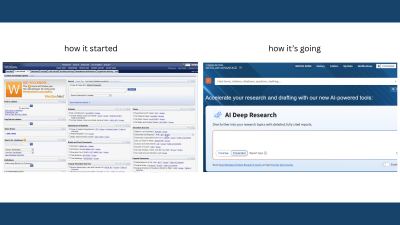
Meet the new Westlaw, same as the old Westlaw?

contrast of westlaw homepages from 2000 to 2026


As the semester has gotten underway, and you’ve logged into Westlaw, you may have noticed that things look very different.  There has been a lot of handwringing about how the new platform design centers its artificial intelligence to do legal research on your behalf.  Rightfully so?  That’s more complicated than it seems at first glance and deserves some in-depth consideration.  Why has Westlaw made this choice?  One that seems to upset legal research experts so much?  It’s worth looking at the history of the company and what guided similar changes in the past to glean some insight.     

John B. West, and his West Publishing Company (founded with brother Horatio) began publishing The Syllabi in 1876.  It was originally a weekly news sheet that reported on cases decided in the Minnesota courts.  The unmet need was timely information about developments in the law, as publication of the opinions took much longer otherwise.  It was wildly successful and their efforts soon expanded into Wisconsin and the product was renamed The Northwestern Reporter.  This is what eventually developed into the West National Reporter system as we now know it.   

But there was a problem.  That’s suddenly a whole lot of case law to digest (no pun intended).  How do you find the opinions relevant for your case?  The West American Digest System was the key (no pun intended) that unlocked the puzzle.  Each case was evaluated by an attorney-editor, who summarized the points of law present.  These are the headnotes you see at the beginning of a West published opinion and still see on the database today.  Those headnotes are then assigned a topic and key and arranged accordingly in a multi-volume set of books called Digests.  In this way, you had a subject index of sorts to find specific points of law and you still do!   

And that was how research was done for close to a century.  Until the advent of … dun dun duuunnn … the computer.   While Lexis was founded as the first company to get the law up and running on a terminal, Westlaw was hot on their heels.  Law schools in 1990 first began giving students codes to create their own accounts and access the database on their own machines.  And having the text of the law electronically available naturally opened up new ways of finding legal materials.   But in the early days of these databases, the information was rigidly organized and to run searches you had to know how to communicate to the database exactly what you wanted using everybody’s favorite, Boolean Terms & Connectors.  So, while the law was more directly available than ever before, you still had to know how things were organized and anticipate the kind of language you hoped to find, and craft your search accordingly.  Also, again, still can to this day! 

This started to change when I first went to law school with the launch of Westlaw Next.  I was warned by my librarians at the time not to rely too heavily on the new interface because I might become addicted and my research skills would suffer as a result.  Sound familiar?  What exactly was on offer with Next that could potentially corrupt my future in the law?  This is when Westlaw made the switch from making users make explicit choices about where and how to search, to putting a giant search bar at the top and telling them to give it a go with natural language searching.  What had changed in the information environment that made Westlaw think this was the future?  In the early 2000s, Google had become so popular that instead of searching the web, we started to refer to it as Googling.  User expectations had shifted. 

I find it ironic that here we are at a moment in history in which Google itself is threatened by the rise of generative AI and shifting its business models accordingly.  Westlaw is simply following suit.  While they have employed AI for years to power its relevancy ranking and who knows what else in the background, it has slowly but surely been releasing new AI forward products since ChatGPT came on the scene.  Which lands us smack dab at the beginning of the semester and a new homepage that now loads with AI Deep Research front and center.  Westlaw is betting that user expectations have shifted once again and wants to be the product that meets the need.   

But does AI Deep Research actually meet the need?  That’s the subject of a much longer blog, but I’ll just share from my own experience, I never got addicted to what Next offered because it was simply an additional tool to take advantage of on the database.  I knew then, and still teach to this day, that all the major developments noted here are still available to us on Westlaw as it exists now, as you’ve already seen me highlight over and over again.  Let’s hope that’s the message that sticks.  Unfortunately, Westlaw has just made it much harder to find how to do so.  At the end of the day, that’s my real beef.  Not with AI itself, but making the full range of search possibilities harder to discover, because you should never be relying on a single technique to get the job done.  If you need help navigating this new landscape, set up a 1-on-1 with the reference team from our homepage, library.law.uconn.edu, and we’ll be glad to show you the history of Westlaw in action from the convenience of your laptop.